



For every property you see in one of our funds, there are several we looked at that didn't make it that far. A site can look great on paper and still fail on sewer, water, new supply, or a road project nobody saw coming.
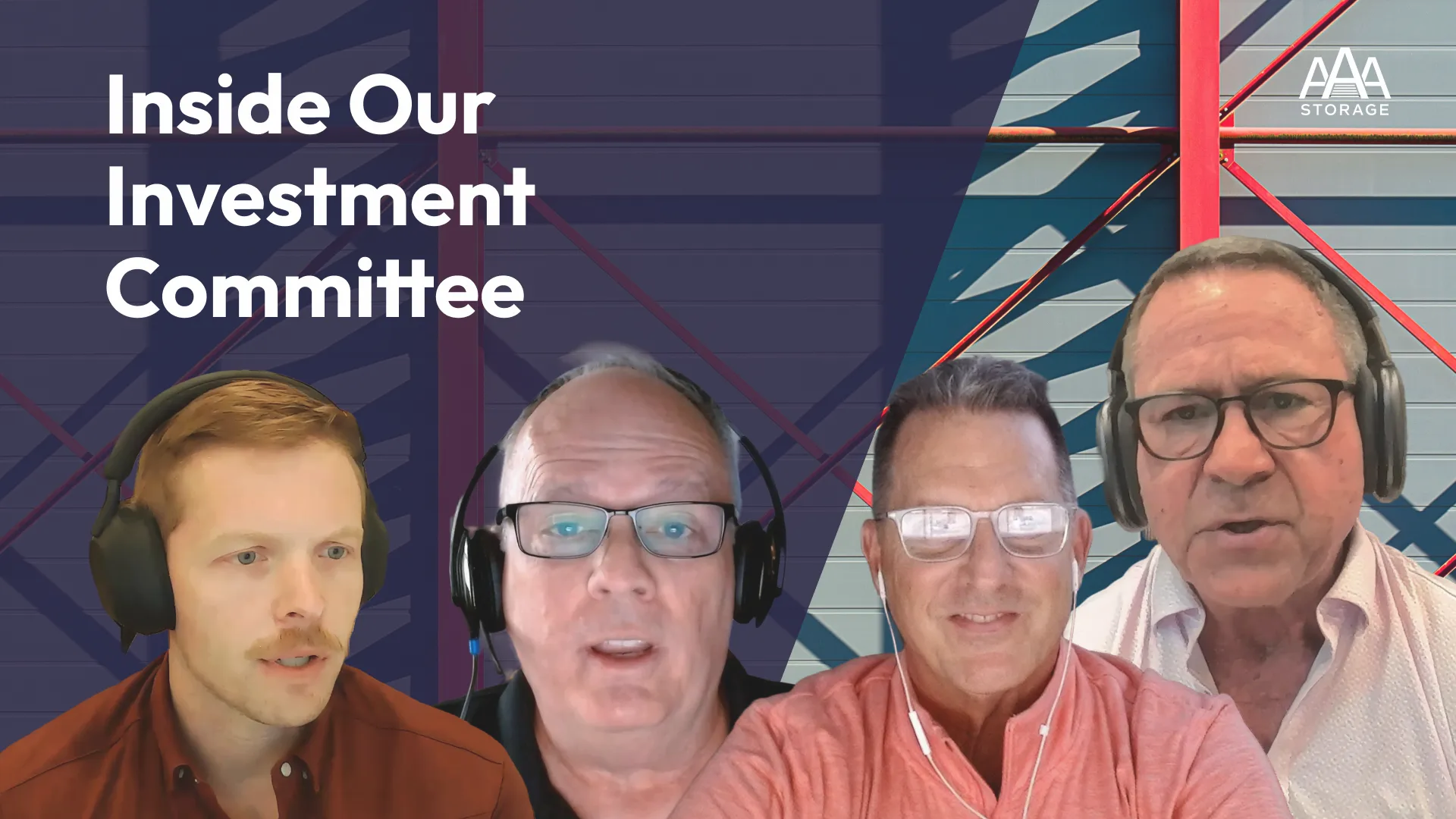
On the latest episode of The AAA Storage Podcast, I sat down with three people who shape every committee decision: Logan Broyles, our lead market analyst; Shawn Beichler, our director of development and construction; and David Lutz, our vice president of property management for self-storage.
Three Votes, Two Years Apart
We land bank sites and get them entitled before they go into a fund, so every project gets at least three committee meetings. The first decides whether to pursue a piece of raw land. The second follows a 45- to 90-day due diligence period and decides whether we buy the land with our own capital. The third comes 18 months to two years later, when a fully designed, costed project is ready to go into a fund.
Is There a Market?
Logan looks at every site as a blank canvas: self-storage, small-bay industrial flex space, both, or neither. Size is the first screen. Our sweet spot is 5 to 10 acres, so a two-acre site is out immediately.
He then defines the trade area, usually a three- to five-mile radius adjusted for natural barriers like lakes and rivers, and studies population, growth, household income, renter-occupied housing, and competition.
The number he watches most closely is market expansion: new supply in the pipeline as a share of what already exists. One million square feet of storage with 200,000 more on the way is 20% expansion. Logan treats 20% as significant, and we weigh it against how fast the market is growing.
Can We Build It, and at What Cost?
Shawn's early review covers entitlement risk, time, and money. Will the city require us to widen the road in front of the site? Is sewer available? Where will the water come from?
On a rural site, the answer can be a well plus a 270,000-gallon fire protection tank costing roughly a quarter of a million dollars or more. A busy road can bring a DOT-required turn lane and deceleration lane costing several hundred thousand dollars to a million or more.
Can We Lease It Up?
David is accountable for delivering the lease-up projections, so he studies rooftops, current and future. When a new high school, Costco, or Walmart is planned nearby, someone has already paid for the research that says the area is growing.
He also separates visibility from access. A pole sign seen from the highway brings in neighbors who never knew we were there, without the cost of a turn lane.
Related reading: behind the scenes of leasing and managing a self-storage facility.
What Changes Before the Final Vote
From land purchase to a stabilized facility can take about six years, so a lot can change. Competitors open nearby. A housing development that was supposed to drive demand gets delayed. A new building code calls for sprinklers. The DOT redesigns the road and changes our access.
By the final review, we have a full design, bids from several general contractors, a financial model, and updated market data. Logan also talks directly with the local planning office to confirm what new supply is really coming.
On one recent project, a number of new facilities went up near our site in the two years after we bought the land. We probably could have leased it up eventually, but it might have taken 10 years. We killed the deal.
David's measure is square feet of storage per capita. Three to five is a strong sign. Seven to nine moves from yellow to red. As he puts it, we can't create demand.
Sometimes the answer is to change the plan instead. When the storage market around our Growth Fund 2 site in Hutto, Texas, became oversupplied, vendors serving a nearby Samsung chip plant needed small-bay space. We redesigned the site as a small-bay industrial park.
Rules still have exceptions. Our Cibolo, Texas, store was built on a road with a traffic count of zero, next to a large housing development that was only 10% complete at the time.
The last step is a review of the pro forma, including yield on cost, and the projected returns to investors, to decide whether they justify the risk we see and meet our standard after more than 30 years of developing for investors.
Key Takeaways
Each project faces at least three investment committee reviews before it reaches a fund.
Site size, trade area, and new supply decide whether a site is worth pursuing.
Utilities, fire protection, road requirements, and permitting can stop a site before design begins.
Markets can change in two years, so the final vote tests everything again.
Square feet per capita tells us whether there is demand to capture.
The final step is a look at the pro forma and projected returns against our standard.
Key Terms
Investment committee: The group that reviews a project and votes on whether it moves forward to a fund.
Land banking: Buying and entitling land with sponsor capital before it goes into a fund.
Entitlement: The approvals, permits, and utility access a site needs before construction can start.
Market expansion: New supply in the pipeline as a percentage of a market's existing supply.
Square feet per capita: A market's total self-storage square footage divided by its population.
Lease-up: The period after a facility opens while it fills with tenants.
Pro forma: A projection of a project’s expected costs, income, and returns.
Yield on cost: A project's projected stabilized net operating income divided by its total cost.
Frequently Asked Questions
How do you choose a site for self-storage development?
We start with size (5 to 10 acres for us), define a trade area of roughly three to five miles, and study population, growth, income, renter-occupied housing, competition, and new supply. Then we check entitlement risk, utilities, and cost before deciding whether to buy.
How much self-storage supply is too much?
We look at square feet of storage per person in the trade area. Three to five square feet per capita is a strong sign for us. Seven to nine moves from caution into the red zone, because a new facility can only take share from existing competitors.
Why would a developer walk away from land it already owns?
The market can change during the 18 months to two years it takes to design and permit a project. If new supply means lease-up could take far longer than projected, it is better to stop than to put investor capital into the project.
What does an investment committee do on a development deal?
It reviews each project and votes on whether it moves forward. Each project faces at least three reviews before it reaches a fund, and at the final vote the team tests everything again, including new supply, because markets can change in two years.
What is yield on cost, and how is it different from a cap rate?
Yield on cost is a project’s expected annual net operating income divided by what it costs to build. A cap rate is net operating income divided by a property’s market value. The gap between the two is the development spread.
Ready to talk about your investment strategy? Contact us at https://www.aaastorageinvestments.com/contact
Follow and Connect with Us
• LinkedIn: https://www.linkedin.com/company/aaa-storage-investments/
• Instagram: https://www.instagram.com/aaastorageinvestments/
• X: https://x.com/investments_aaa
• Facebook: https://www.facebook.com/people/AAA-Storage-Investments-LLC/61575027573292/

Find more expertise.

Stay updated with our newsletter.
Subscribe now for the latest news, tips, and exclusive content delivered straight to your inbox.
