



Many of the investors in our funds use retirement capital, and many more ask whether they can. This article is for accredited investors weighing a self-directed IRA or a Solo 401(k) for private real estate. It covers what these accounts can hold, the rules that trip people up, and the tax issue that comes with leverage.
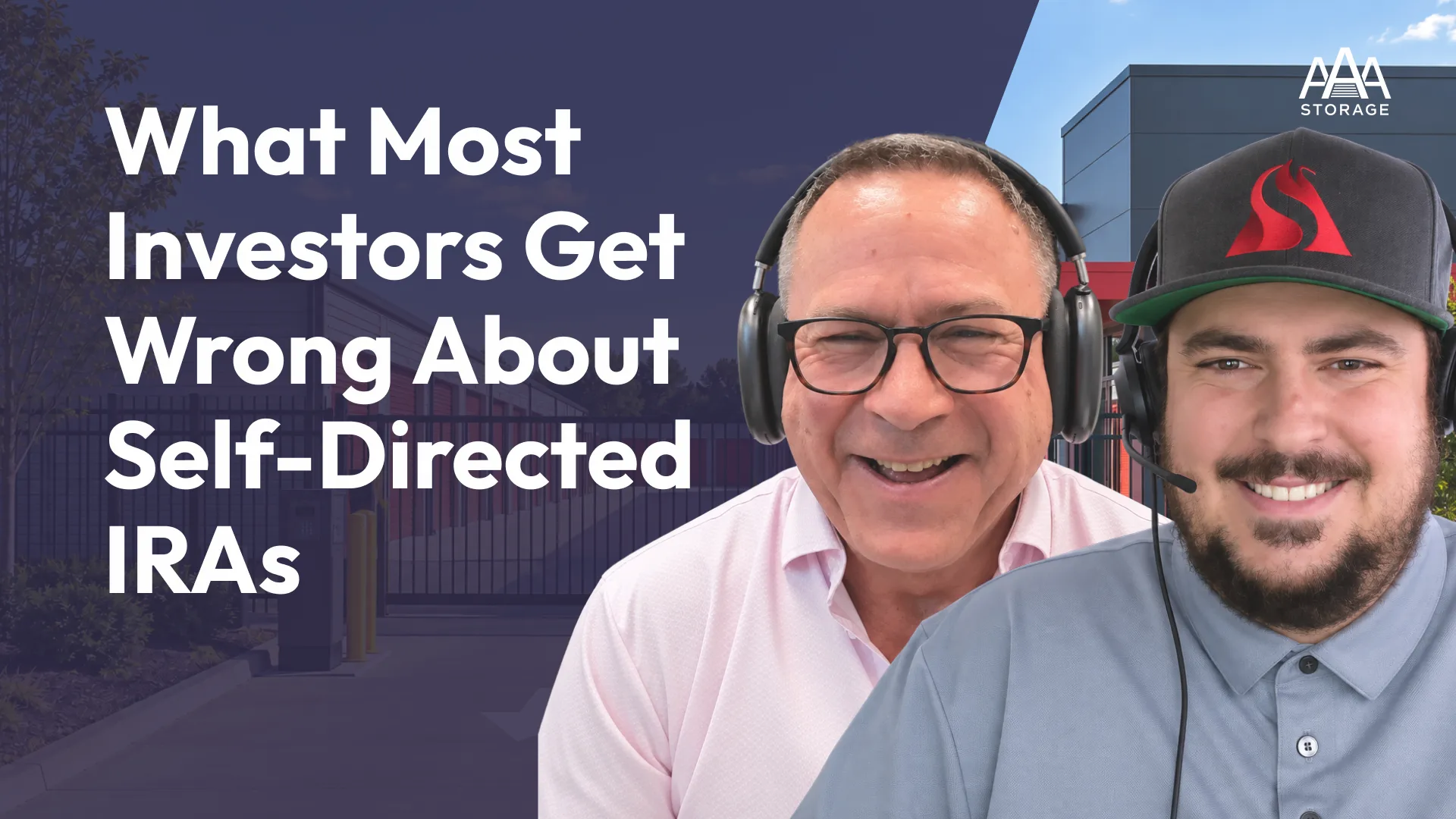
On the latest episode of The AAA Storage Podcast, I sat down with Travis Rhodes of Safeguard Advisors, a firm that specializes in checkbook control accounts. The conversation also gave me a chance to correct two points I made on episode 46.
Most "Self-Directed" IRAs Aren't
A self-directed IRA is an IRA set up to hold alternative assets, such as private real estate, alongside stocks and funds. A brokerage IRA where you pick your own stocks is not one.
Travis told me that when people stopped at Safeguard's booth at the Limitless conference in Scottsdale and were asked about self-directed IRAs, almost all of them said they already had one. A few follow-up questions showed that most meant a brokerage account. The difference matters, because the IRS doesn't publish a list of what you can own. It lists what you can't, such as collectibles and life insurance. Nearly everything else is on the table.
The IRS Cares Who You Invest With
The rules that catch investors are about prohibited transactions and disqualified persons, not asset classes. Your IRA can't deal with your lineal family: parents, children, grandparents and grandchildren. Siblings, aunts and uncles fall outside that line.
You also can't benefit personally. If your IRA owns a vacation home, you can't stay there, even if you pay market rent. If it owns a rental, Travis recommends a third-party manager, because even changing a light bulb yourself counts as sweat equity. Investing passively in a real estate fund with an unrelated sponsor typically doesn't raise these concerns.
Checkbook Control Puts the Paperwork on You
With checkbook control, your account funds an LLC, and you invest by writing the check or wiring the money yourself, without waiting on a custodian. That speed comes with responsibility. You keep the records. You sign as manager of the LLC, never as yourself. And you never cover an expense with personal funds, even in an emergency. Forming the LLC can take a day. Transferring an existing account usually takes two to four weeks.
Self-Directed IRA Real Estate Investment and Leverage
If an investment uses debt, an IRA can owe tax on unrelated debt-financed income, or UDFI. Many investors assume that only applies when they take out the loan themselves. It also applies when the fund they invest in borrows. On episode 46, I called this unrelated business income tax. UDFI is the more precise term.
A Solo 401(k) is a different kind of account. It can generally hold leveraged real estate without UDFI, subject to conditions your tax advisor should confirm.
Where the Solo 401(k) Fits
You can qualify with self-employment income and no employees other than a spouse. A W-2 job doesn't disqualify you. Board fees, consulting and freelance work can count. In 2026, the IRA contribution limit is $7,500, while a Solo 401(k) allows up to $72,000 in total contributions if your earned income supports it. You can roll a traditional IRA into a Solo 401(k) without reducing what you can contribute. A Roth IRA can't be rolled into a 401(k).
That brings me to my second correction. On episode 46, I said you only needed to qualify on the day you open a Solo 401(k). Travis was clear that you need to keep earning some self-employment income each year, or the plan can terminate.
Key Takeaways
Most people who say they have a self-directed IRA have a brokerage IRA with a menu of stocks and funds.
The IRS cares less about what your IRA owns than about who it deals with.
If your IRA invests in a fund that uses leverage, unrelated debt-financed income (UDFI) can apply, even if you never signed a loan.
A Solo 401(k) can generally avoid UDFI on real estate debt and allows far higher contributions, but only while you keep earning self-employment income.
Key Terms
Self-directed IRA: An IRA administered to hold alternative assets, such as private real estate, as well as stocks and funds.
Checkbook control: A structure in which the account funds an LLC that the owner manages, so each investment doesn't have to go through a custodian.
Disqualified person: Someone your IRA can't transact with, including you and your lineal family.
Prohibited transaction: A deal that benefits you or a disqualified person directly, such as using a property your IRA owns.
Unrelated debt-financed income (UDFI): Income an IRA earns from debt-financed property, taxable inside the account.
Solo 401(k): A 401(k) for self-employed people with no employees other than a spouse.
Frequently Asked Questions
Can a self-directed IRA invest in a private real estate fund?
Yes. A self-directed IRA can hold private placements, including real estate funds, as long as the investment doesn't involve a prohibited transaction or a disqualified person. With checkbook control, you sign the subscription documents as manager of the account's LLC.
Does my IRA owe tax if the fund uses leverage but I didn't borrow?
It can. UDFI applies when the investment itself is debt-financed, including debt at the fund level. Ask your tax advisor to estimate the effect before you invest.
Can I roll my IRA into a Solo 401(k)?
A traditional IRA, yes, in full or in part, and the rollover doesn't reduce what you can contribute. A Roth IRA can't be rolled into a 401(k).
Do I need ongoing self-employment income to keep a Solo 401(k)?
Yes. You need to keep showing some earned income from self-employment each year. It doesn't have to be the same amount.
How long does it take to set up a checkbook control IRA?
Forming the LLC can take anywhere from the same day to a few days, depending on the state. Transferring an existing IRA or 401(k) typically takes two to four weeks.
Ready to talk about your investment strategy? Reach out at https://www.aaastorageinvestments.com/contact
Follow and Connect with Us
LinkedIn: https://www.linkedin.com/company/aaa-storage-investments/
Facebook: https://www.facebook.com/people/AAA-Storage-Investments-LLC/61575027573292/
This article is for informational and educational purposes only. It is not investment, legal, tax or accounting advice, and it is not an offer to sell or a solicitation to buy any security. Consult your own CPA, tax advisor and legal counsel before making any decision about a retirement account or an investment. All investments carry risk, including the loss of principal.

Find more expertise.



Stay updated with our newsletter.
Subscribe now for the latest news, tips, and exclusive content delivered straight to your inbox.
