
Passive Real Estate Investing Isn't Passive: Lessons From Both Sides of the Table | AAA Storage




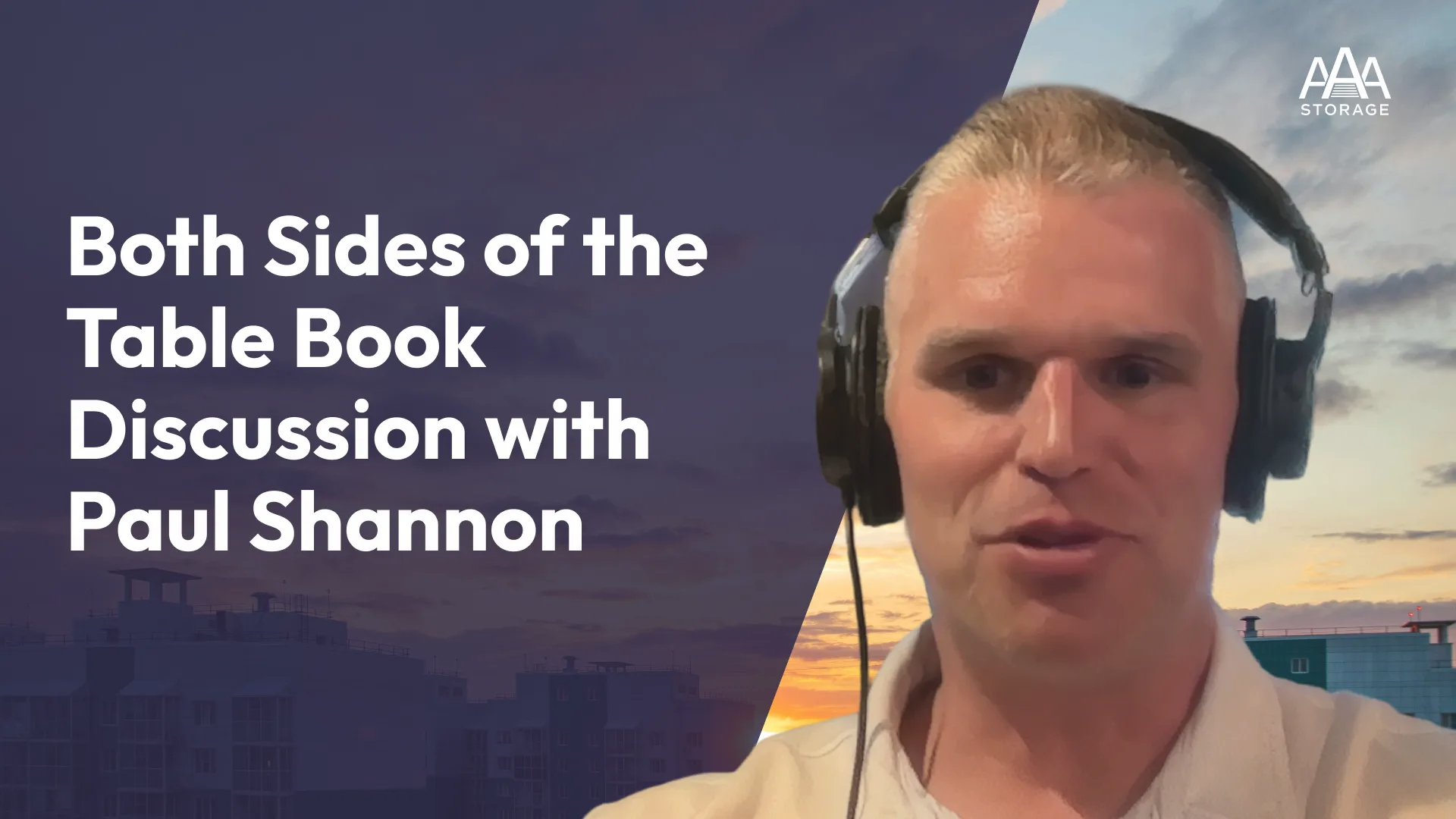
Paul Shannon has sat on every side of the table. He has been a general partner executing a business plan, a fund manager placing investor capital into other sponsors' deals, and a limited partner in nearly 45 deals across 10 years. His new book, Both Sides of the Table, is the most comprehensive resource I have seen on how passive investors should actually evaluate private real estate.
We bought a copy for every member of our executive team.
Paul joined me on The AAA Storage Podcast to talk through it.
The LP Seat Teaches Vulnerability
Of the three seats, Paul has spent the most time as an LP, and the word he uses for it is vulnerability. You control the decision up front. Once you wire the money, you are at the mercy of the sponsor, in an illiquid asset, for five, seven, or ten years.
That is why the up-front decision carries so much weight, and why the pro forma deserves a skeptical read. "I've never once had a deal that's actually hit the pro forma," Paul told me. "It's either underperformed or overperformed." What matters is whether the deal has enough margin of safety to hold up either way.
Think Like an Allocator, Not a Consumer
Glossy pitch decks, polished webinars, and "only a few spots remain" are consumer marketing tactics. Sponsors use them for the same reason retailers do: they work. Paul's answer is the joy of missing out. As my father told me a long time ago, there's never one of anything.
The consumer sees a 19% projected IRR and asks what they can make. The allocator asks what inputs produce that 19%, whether those inputs are realistic, and where the margin of safety is. The allocator also asks whether a track record was built on the tailwinds of 2014 to 2020, and where we are in the market cycle. Sometimes, as Paul put it, "the best policy is to not act at all."
Character Over Track Record
Character is the hardest thing to evaluate, because you don't see it until something goes wrong. Paul's first question is about a sponsor's worst deal, not their best: "how they communicate and how they talk about failure is much more relevant to me than successes they've had."
He also looks for meaningful skin in the game, and for sponsors who have been LPs in other people's deals, so they know what it feels like to wire capital and give up control. The book includes 50 questions to bring to a sponsor call, so the sponsor doesn't spend the full 30 minutes on their own talking points.
When Value-Add Starts to Look Like Development
Many investors assume ground-up development is inherently riskier than buying an existing asset. Paul offers two tests that complicate that assumption.
The first is IRR partitioning: how much of the projected return comes from operating cash flow and how much from the sale at exit. When cash flow is only a small slice, the deal depends on an exit cap rate years away, just like development, but with an older building's problems.
The second is yield on cost. Divide stabilized net operating income by total project cost, then compare it with the market cap rate for similar product. That spread is where value is created. In Paul's example, a sponsor buys for $4 million, invests $1 million, and stabilizes at a six cap on total cost in a six-cap market. A lot of work, and no value created.
This is the same discipline we apply to ground-up self-storage development. Whatever the strategy, make sure the spread exists before you invest.
Lead With Risk
Paul's closing advice: "lead with risk, not with returns." Start with the partnership documents, then the underwriting, then the market. Build your LP portfolio over years, diversified by asset class, sponsor, geography, property class, and debt maturity, rather than deploying everything at once.
Make sure you pick up a copy of Both Sides of the Table.
Key Terms
Limited partner (LP): A passive investor in a private real estate deal. LPs commit capital but do not control the business plan.
General partner (GP): The sponsor who executes the business plan and acts as a fiduciary to the LPs.
Pro forma: A sponsor's projection of a deal's income, expenses, and returns.
IRR partitioning: Splitting a projected IRR into the share that comes from operating cash flow and the share that comes from the sale at exit.
Yield on cost: Stabilized net operating income divided by total project cost.
Development spread: The difference between yield on cost and the market cap rate for similar product.
Frequently Asked Questions
Is passive real estate investing actually passive?
Not at the evaluation stage. Paul Shannon argues that investors need to review many deals to build pattern recognition, ask sponsors hard questions, and keep tracking performance after they invest.
What should I ask a sponsor before investing?
Start with their worst deal and how they communicated it to investors. Then ask how much of their own capital is in the deal, and whether they have invested as an LP in other sponsors' deals.
Is development riskier than value-add?
Not automatically. A value-add deal that relies mostly on the exit sale, and creates no spread between yield on cost and the market cap rate, can carry development-level risk without the benefit of a new building.
Ready to talk about your investment strategy? Reach out at aaastorageinvestments.com/contact
Find more expertise.


Stay updated with our newsletter.
Subscribe now for the latest news, tips, and exclusive content delivered straight to your inbox.
